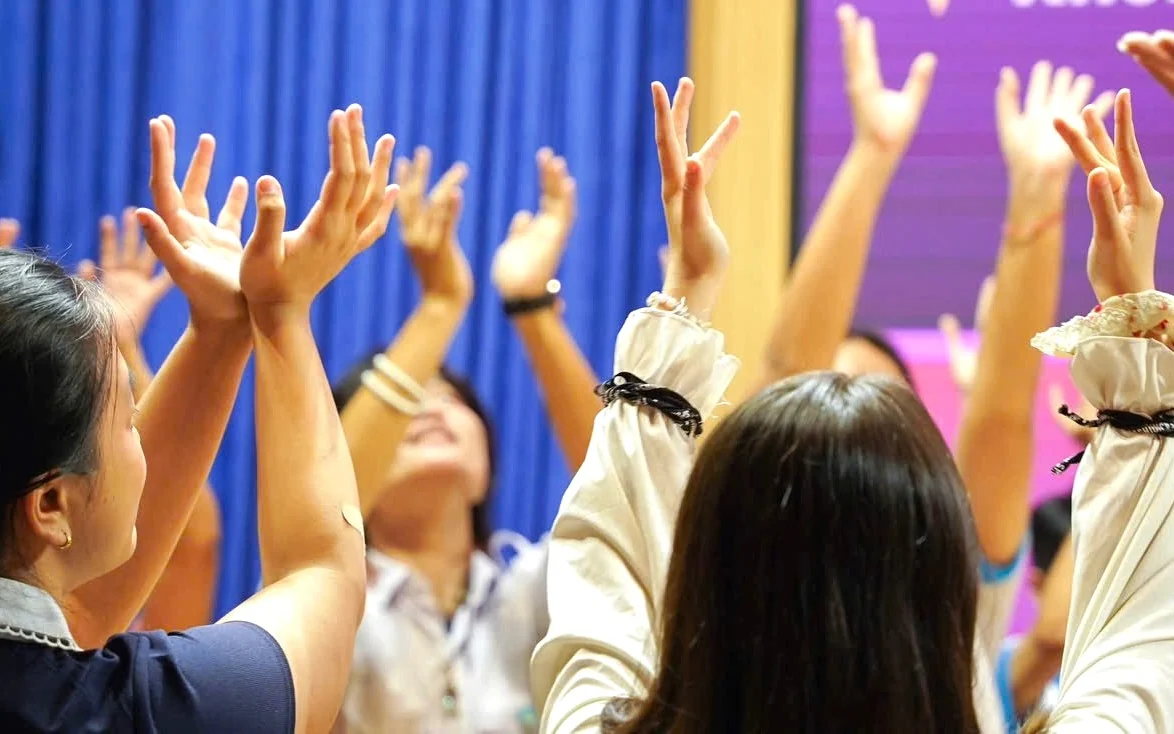
Movement is not about producing a beautiful performance.
Discover DMTWhen the body
When the body
has a voice.
Dance/Movement Therapy (DMT) is a therapeutic field that uses the body and movement as part of exploring emotion, relationship, and lived experience.
What is DMT?
Movement as a language of experience.
Dance/Movement Therapy uses the body and movement as part of the therapeutic process, alongside verbal reflection when appropriate.
Core principles in how VDMT introduces DMT01 02 03
Participants are invited to notice sensation, gesture, rhythm, and the body's responses.
Movement experience opens another pathway to notice, express, and understand what can be difficult to put into words.
How VDMT introduces the process
Awareness. Expression. Connection. Integration.
These four movements are VDMT’s way of helping newcomers picture an embodied process; they are not the only definition or a required model for the entire DMT field.
Awareness
Notice sensation, emotion, breath, rhythm, and signals from the body.
Expression
Allow movement to give form to experiences that may be difficult to express in words.
Connection
Meet self and others through attunement, boundaries, choice, and safe relationship.
Integration
Translate embodied experience into meaning, choice, and inner resources for daily life.
Where is DMT used?
Across care, learning, and community settings.
DMT can be practiced in different settings. Its scope, aims, and methods need to fit the people involved and the relevant professional context.
Mental health
Individual or group spaces for exploring emotion, relationship, and embodied experience.
Healthcare & care settings
Programs that support connection with the body and lived experience within care contexts.
Education
Experiential learning that can nurture body awareness, creativity, and connection.
Community
Group movement practices that expand opportunities for participation, expression, and social connection.
Understanding DMT
How is DMT different from Dance and Creative Arts Therapies?
Dance/Movement Therapy
A therapeutic practice using movement and interaction with therapeutic intention, delivered within an appropriate professional scope.
Dance & Creative Dance
An artistic language for expression, creativity, and connection. The experience may be beneficial, but it is not automatically psychotherapy.
Creative Arts Therapies
A family of therapeutic fields using different art forms. DMT focuses specifically on the body, movement, and relationship.
DMT in Vietnam
A field being developed in the Vietnamese context.
VDMT was founded in 2015 to develop Dance/Movement Therapy in Vietnam by connecting international professional foundations with Vietnamese culture and real-world needs.
Read the VDMT storyCommon misconceptions
Understanding before beginning.
Do I need dance experience?
No. DMT does not require dance technique or performance experience. Movement begins with each person’s abilities and lived experience.
Is DMT the same as a dance class or movement workshop?
No. Dance classes, movement experiences, and DMT have different aims, scopes, and professional requirements. VDMT distinguishes therapy, experiential learning, and education so people can choose what fits their needs.
Should I begin with therapy or a course?
If you are seeking support for personal needs, start with a conversation about therapy. If you want to understand the field or learn through experience, explore the programs and courses that fit your goals.
Where should I begin if I want to pursue DMT professionally?
Start by understanding the field, choosing appropriate learning experiences, and speaking with VDMT about current professional education pathways. Degree, credentialing, and scope-of-practice requirements depend on the program and relevant professional standards; VDMT can help distinguish experiential learning, professional education, and therapeutic practice.
Explore further
Knowledge & research from VDMT.
Go deeper into embodied experience, Body Wisdom, and the differences between therapy, learning, and movement practice.